📅 March 4, 2026 | Category: Marriage & Relationships | Posted by Admin
It was a Tuesday evening.
I remember because the children had just finished their homework and the house was finally quiet. I had cooked his favourite — egusi and eba — and set it the way he likes it. I even lit a small candle on the dining table. Nothing dramatic. Just a small thing.
He came in, saw the food, sat down, and reached for his phone.
He ate the entire meal scrolling. He didn't say it was good. He didn't look up. When he finished, he carried his plate to the kitchen, went to the bedroom, and that was it.
I stood in the kitchen for a long time.
Not crying. Just standing. Staring at the candle I had lit for a dinner that nobody noticed.
Is this my life?
Maybe you know that feeling. Not the dramatic kind of marital pain that people talk about openly — the fighting, the shouting, the obvious crisis. This is the other kind. The quiet kind. The kind where everything looks fine from the outside and feels hollow from the inside.
He's there. He provides. He's not a bad man. But somewhere between the second child and the fifth year of marriage, he stopped seeing you. And you stopped expecting him to.
You dress up for church and he walks past you to find his keys.
You try to start a conversation and get three words back.
You reach for him at night and feel the distance even with him right there.
This is just what marriage becomes, you tell yourself. Everyone goes through this. This is normal.
But deep down, in the part of you that you don't show anyone, you know it's not the marriage you wanted. And you're running out of ideas for how to change it.
You've tried the dinner. You've tried the talk. You've tried the prayer. You've tried dressing up, showing up, showing out. Nothing has moved him.
And now you're here. Reading this. At whatever hour you're reading this. Quietly hoping that maybe this time, something will be different.
Drop everything you are doing now and listen to every word I'm about to say.
"Because I'm about to share with you a quiet method that changed everything for me — and for the marriage I had almost given up on."
Our grandmothers didn't go to couples therapy. They didn't read relationship books or attend marriage seminars. And yet — the women in that generation who knew the secret kept their husbands warm and close for decades.
Not through submission. Not through suffering. Through something quieter. Something specific. A set of small, deliberate actions that shifted the emotional energy between a husband and wife — without a single confrontation, without pressure, and without the husband even knowing anything was being worked on.
This method has been quietly passed from woman to woman for generations. Most modern wives never hear of it. I almost didn't.
Hi. My name is Ada.
First thing you should know about me — I am NOT a relationship counsellor. I am not a therapist. I have no certificate on my wall. I'm just a 39-year-old woman from Imo State, living in Lagos, married for 11 years, with two children and a marriage that went so cold I could feel it in my chest every morning.
I know what it feels like to smile at a party while your husband stands on the other side of the room and doesn't once come to find you.
I know what it feels like to reach for someone in the night and feel the distance even with them right there.
And I know — because I lived it — what it feels like when that changes.
Let me tell you the whole story. Because I need you to understand that where you are right now — I was there too. Maybe worse.
It started slowly. The way most dangerous things do.
Our second child was born in 2020. The lockdown year. Emeka — my husband — was working from home, I was on maternity leave, and we were suddenly together every hour of every day.
You'd think that would bring couples closer. For us, it did the opposite.
We ran out of things to say to each other. We were both exhausted. Both stressed. Both pouring everything we had into the children, the work, the survival of that strange locked-down year.
And somewhere in those months — quietly, without either of us noticing — we stopped being a couple. We became co-managers of a household.
By 2021 we were functioning perfectly well as parents and housemates. As husband and wife, we were somewhere between roommates and strangers.
The emotional cost was things I didn't even have words for at the time.
I stopped getting dressed up when we went out together. What was the point? He wouldn't notice either way.
I stopped initiating conversation after work because every attempt ended in monosyllables.
Fine. Okay. I'm tired.
I stopped reaching for him at night. Not out of anger. Just because it had become… awkward. Like reaching for someone who isn't quite there.
And the worst part? I stopped being surprised by any of it. I had normalised a marriage that was slowly going quiet.
The breaking point came on a Friday night in February 2022.
We were at a friend's dinner. Someone made a toast. "To love that grows stronger with time." Everyone clinked glasses and smiled. I smiled too. Emeka didn't look at me. Not once. Not even to share the moment.
I went to the bathroom and sat on the edge of the tub for ten minutes.
Is this it? Is this just... my life now?
That night I called my Auntie Ngozi — my mother's older sister, who has been married for 30 years and is one of the wisest women I know. I told her everything. In the dark, in a low voice so Emeka wouldn't hear from the other room.
She was quiet for a long time. Then she said:
"Ada. Stop trying to pull a man toward you by talking at him. Men don't come back through words. They come back through feeling. You have to change what he feels when he's around you — not what he hears."
I didn't fully understand what she meant. But those words stayed with me.
So I tried everything I could think of.
I booked a couples dinner for our anniversary. A proper restaurant in Victoria Island — candles, good wine, the whole thing. He came. He spent most of the evening on his phone checking his work messages. By the main course we had run out of things to say. I paid the bill and we drove home in silence.
I bought new lingerie. I spent more money than I should have. He was responsive once. Then nothing. Back to routine within a week.
I tried "the talk." I planned it carefully. I waited until the children were asleep. I sat down beside him and I said, calmly, that I felt like we were drifting. What followed was not a conversation. It was an argument that lasted three days and ended with nothing resolved and both of us more guarded than before.
A colleague told me about a marriage seminar at her church. I convinced Emeka to come. He sat through it with his arms folded. He agreed it was "interesting." He never mentioned it again.
I saw a counsellor alone for two months. She was good. She helped me understand my own feelings. But nothing changed at home because I was the only one doing the work.
I fasted and prayed for 21 days. My faith carried me through it. The distance didn't move.
Nothing worked. And I was running out of ideas — and energy — to keep trying.
Then came Mama Remi's 70th birthday celebration.
It was in Abeokuta. A proper Yoruba family celebration — a big hall, aso-ebi, music, three kinds of rice. Mama Remi is Emeka's mother's older cousin. She has been married for 49 years. Her husband — Papa Remi — still opens doors for her. Still holds her hand when they walk. At 70 years old, the man still reaches for her.
I had always noticed this about them. But that evening, watching them move around the room together, something about it broke me open a little.
What does she know that I don't?
I had stepped outside the hall. I needed air. I was tired of performing happiness and I needed a moment where nobody needed me to smile.
I didn't hear her follow me out.
I was standing under the mango tree, fanning myself, staring at nothing, when Mama Remi came and sat on the bench beside me.
She didn't say anything immediately. She just sat. Then she looked at me with those sharp, warm eyes of hers and said:
"I've been watching you all evening. Your husband doesn't see you. But that's not because he stopped loving you. It's because you both forgot how to speak the language."
I didn't know whether to cry or ask what she meant.
I asked.
What followed was a two-hour conversation I will never forget for as long as I live.
Mama Remi told me that every marriage has a language. Not words — a language made of signals. Small actions. The way you enter a room. The way you leave one. The way you respond to him before he speaks. The rhythm of your presence around him.
"When you were new to each other," she said, "you were speaking that language without knowing it. Everything you did sent him a signal. He felt it. That's why he couldn't leave you alone. Somewhere in the business of life you stopped sending the signals. He stopped feeling you. And a man who cannot feel his wife will go quiet. Not because he doesn't love her. Because he doesn't know where she went."
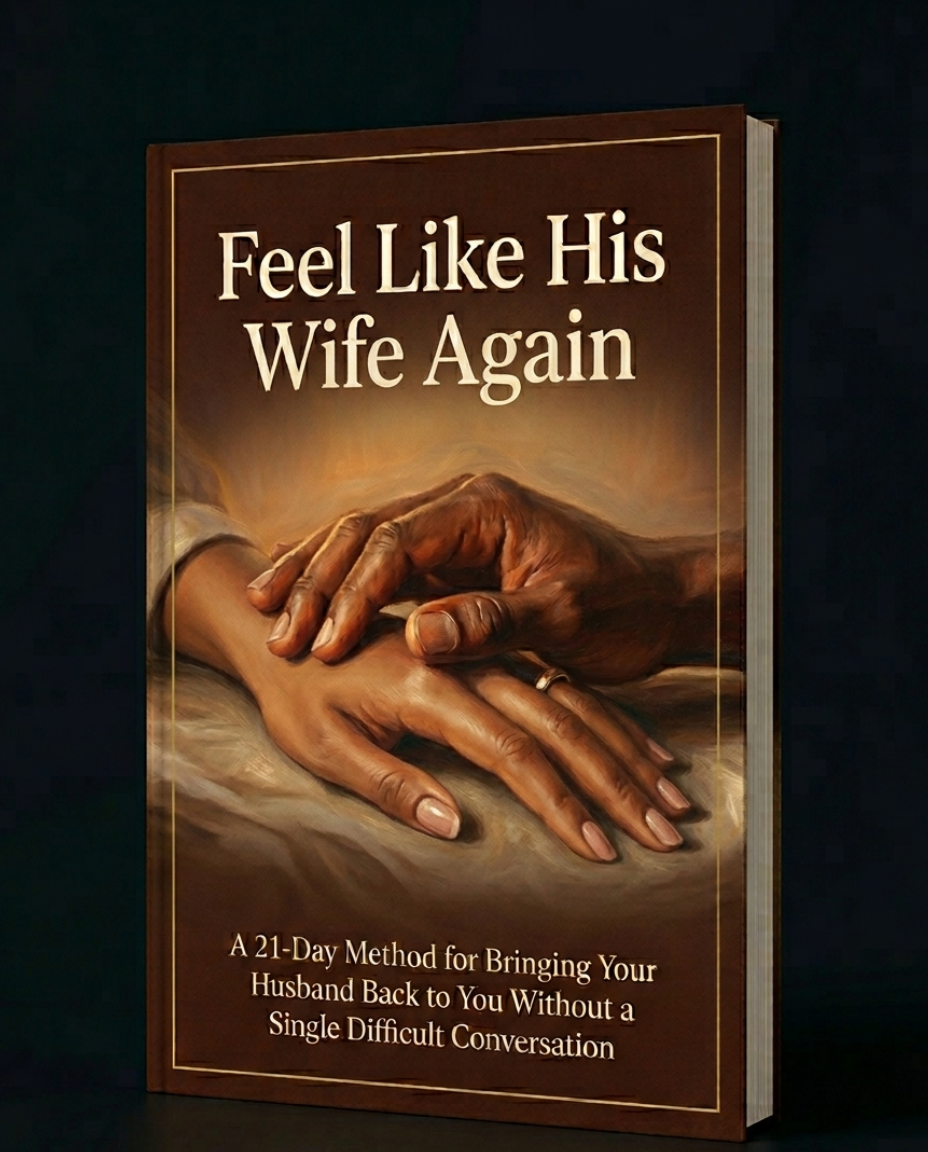
She told me about the 21 quiet days. A series of small, specific daily actions — drawn from the kind of wisdom her own mother had passed to her, and her grandmother before that. Actions that shift the emotional energy between a husband and wife. Not tricks. Not manipulation. A deliberate return to the signals that made him choose her in the first place.
"You don't need him to know you're doing anything. You don't need a single difficult conversation. You just need to change what he feels when he's around you. Do these things for 21 days and watch what happens."
I sat there thinking: This sounds too simple. There's no way this is the answer. I've tried everything big and this woman is telling me to do small things?
But I had run out of big things to try.
I started on a Monday.
Day 1 was almost embarrassingly simple. Four minutes. One small action. No conversation required. I did it and thought, this cannot possibly do anything.
Days 2, 3, 4. Nothing obvious. Emeka was the same. I was beginning to feel foolish.
Day 5. Something so small I almost missed it. He looked up when I walked into the room. Not at his phone, not at the TV. At me. For about three seconds. Then back to whatever he was watching.
It sounds like nothing. But I knew my husband. That look had been absent for two years.
Day 6 — I felt it shift.
He came into the kitchen while I was cooking. He didn't need anything. He just came in and stood near me. We talked about nothing — the children's school, something he'd read online. But he came to find me. He hadn't done that in so long.
I went to bed that night and something in my chest that had been tight for years was a little looser.
By Day 14 — he was coming to find me in the evenings. Not every night. But regularly. He'd come and sit near me. Sometimes we'd talk. Sometimes we'd just be in the same space. But he was choosing to be near me again.
Day 21.
We were watching something on TV. The children were asleep. Nothing special was happening. And then — he reached across and took my hand.
He hadn't done that in over two years.
I didn't say anything. I just held his hand and looked at the screen and quietly, in my chest, I was shaking.
A few days later he looked at me and said:
"Ada, I don't know what it is, but you seem different lately. I like it."
He had no idea. He just felt it.
I wasn't the only one at Mama Remi's celebration who had that conversation with her.
Temi — one of Emeka's cousins, married 8 years — had also slipped out of the hall that evening. Mama Remi had spoken to her too, briefly. Temi told me three weeks later that by Day 10, her husband had suggested they go for a walk together after dinner. Just the two of them. "He hasn't suggested anything like that in four years," she told me, laughing and crying at the same time.
Kemi — a friend I'd mentioned it to quietly — tried it without telling me until it was working. She texted me on Day 17: "Ada, what did you give me? This man just apologised to me out of nowhere for something that happened six months ago. He said he'd been thinking about it. He's been thinking about ME."
Funmi — a woman from our church who I'd shared it with after she confided in me about her own cold marriage — called me on Day 22. She said her husband had come home early from work for the first time in two years, picked up their daughter from school without being asked, and brought her food from her favourite restaurant on the way home. "He just wanted to do something nice for me," she said. "I didn't ask for anything. He just wanted to."
The method works. Not for every marriage the same way. But it works.
After sharing this with a handful of women privately, the messages wouldn't stop.
"Ada, please can you send me the full list of the 21 actions?"
"Ada, I need this. Where do I start?"
"Please, I need to know exactly what to do on Day 1."
I couldn't keep up. And I couldn't keep sharing pieces of it in voice notes and messages. It needed to be written down properly — every action, in order, with the reasoning behind each one, so a wife could start today and know exactly what to do every single day for 21 days.
So I wrote it all down. Everything Mama Remi shared with me under that mango tree. Everything I learned from doing it myself. Everything I've seen work in the lives of the women I've quietly shared it with since.
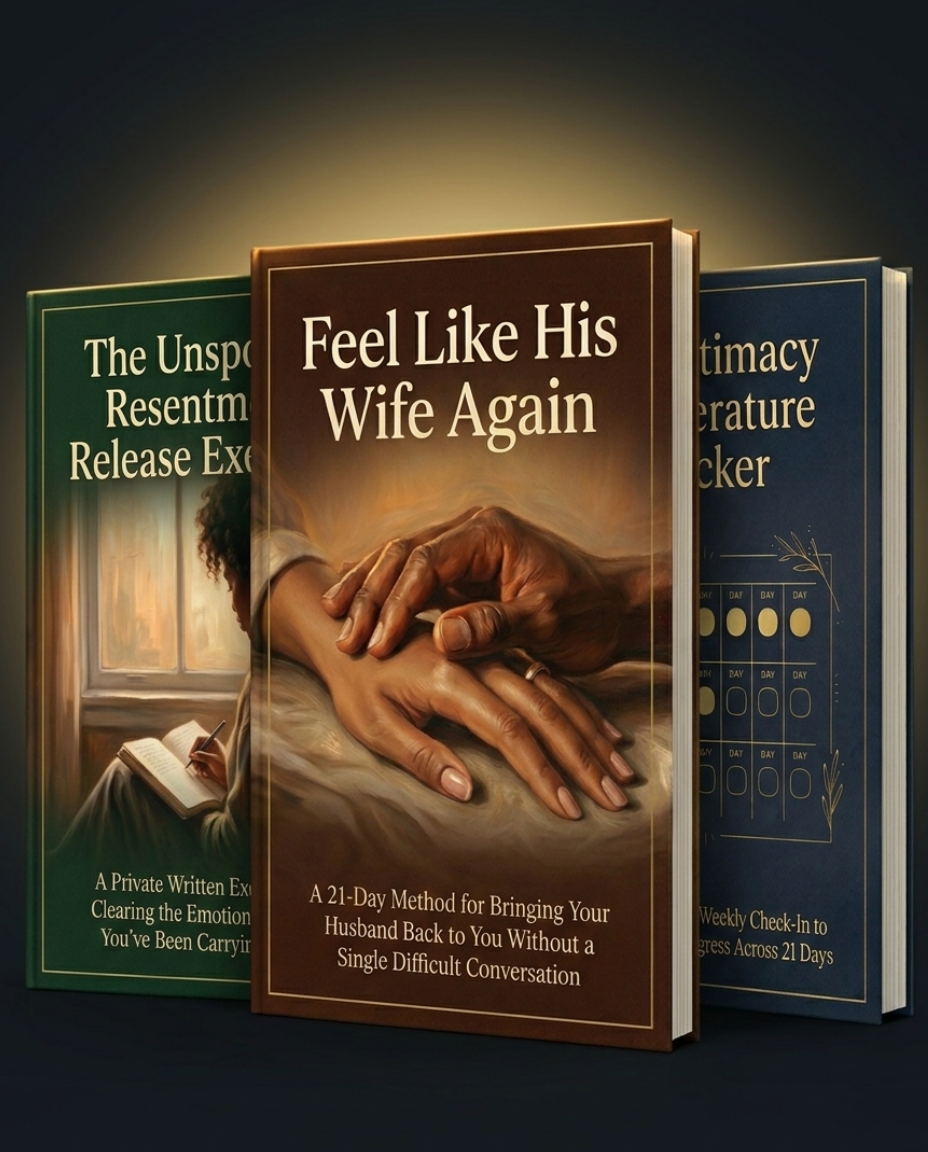
I put everything — the complete method, the exact daily actions, the specific phrases, the rituals, the progression — inside one simple guide you can start reading and using today.